
How Bone Loss Affects Dentures and How Implants Help Preserve Your Facial Structure
Updated: Apr 22
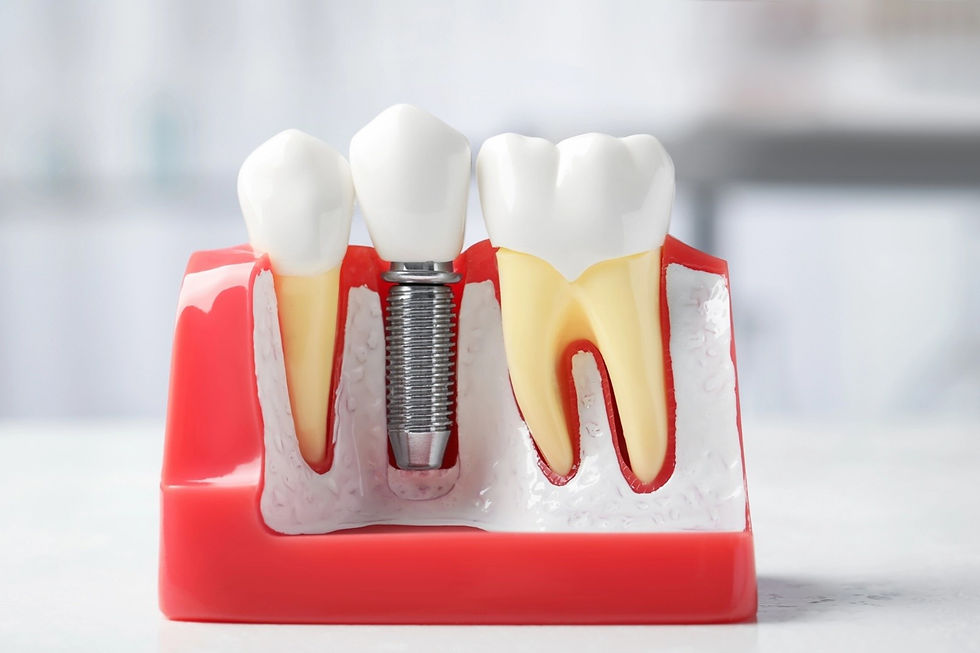
There's a conversation that doesn't happen often enough when patients first lose a tooth or transition to dentures: what happens to the jawbone underneath. Most people are focused on restoring their smile and getting back to eating comfortably, understandably so. But the changes taking place beneath the surface matter just as much as what you can see in the mirror.
At Dr. Crapo & Associates, we believe patients deserve a complete picture. Understanding how tooth loss affects the bone, and how different replacement options respond to that reality, is essential to making a decision you'll feel confident about for years to come.
What Happens to Your Jawbone After Tooth Loss?
Your teeth do more than help you chew and speak. They constantly stimulate the jawbone through the pressure of biting and chewing. That stimulation signals the body to maintain bone density in the area. The moment a tooth is lost, that signal disappears.
Without stimulation, the body begins a process called bone resorption, essentially, it starts reabsorbing the bone tissue in that area because it no longer perceives a need to maintain it. This isn't a rare complication. It's a predictable biological response that begins within the first year after extraction and continues gradually over time.
In the early stages, bone loss may be barely noticeable. But over several years, the cumulative effect becomes visible: the jawbone shrinks in both height and width, which can cause the lower third of the face to appear to collapse inward. Lips may look thinner, the chin can appear more prominent, and the overall facial profile begins to change in ways that are difficult to reverse.
How Dental Implants Interrupt the Bone Loss Cycle?
This is where implant dentistry fundamentally changes the equation. A dental implant in Victoria is a small titanium post that is surgically placed into the jawbone to act as an artificial tooth root. Over several weeks, the implant undergoes a process called osseointegration, the surrounding bone tissue fuses directly with the titanium surface, incorporating the implant as part of the jaw's structure.
Once integrated, the implant transmits chewing forces into the bone just as a natural tooth root would. This stimulation preserves bone density and volume in a way that no surface-resting prosthetic can replicate. Patients who receive implants early after tooth loss can often maintain the jaw structure, they have rather than spending years trying to recover what was lost.
The aesthetic benefit is equally meaningful. When the bone is preserved, the overlying facial tissues, gums, lips, cheeks, retain their natural support. The facial changes associated with long-term tooth loss and conventional dentures can be substantially reduced or avoided altogether.
Implant-Supported Dentures: Stability and Bone Preservation Together
For patients who are missing all or most of their teeth, dentures supported by implants offer a compelling middle ground between the familiarity of a denture and the bone-preserving benefits of implants. Rather than resting passively on the gums, an implant-supported denture anchors to a series of strategically placed implants, typically two to four in the lower jaw, providing a level of stability that conventional dentures simply cannot match.
The difference in daily experience is significant. Patients report far greater confidence eating, speaking, and smiling. Foods that were off-limits with loose conventional dentures, many fruits, fibrous vegetables, certain proteins, become accessible again. And because the implants are stimulating the bone beneath, the accelerated resorption associated with traditional dentures is dramatically reduced.
For patients seeking a more permanent, fixed solution, “Teeth in a Day”/“All‑on‑4® implants” offer a full-arch restoration supported by just four implants per jaw. This approach delivers a fixed prosthetic that is cleaned and maintained like natural teeth, with no removal required. For patients who have experienced significant bone loss, the “Teeth in a Day”/”All‑on‑4® implants” technique is often designed to work with available bone anatomy, reducing the need for bone grafting in many cases.
Depending on the extent of tooth loss and individual anatomy, implants with bridges or single implants with crowns may also be appropriate for patients replacing one or several teeth rather than a full arch. Each option carries the same core advantage: bone stimulation, stability, and long-term structural preservation.
Addressing the Challenges That Come with Tooth Loss
It's worth acknowledging that the path to implant-supported solutions isn't always straightforward. Patients who have worn conventional dentures for many years may have experienced enough bone loss to require preparatory treatment before implants can be placed. In some cases, bone grafting is needed to rebuild volume; in others, the “Teeth in a Day”/”All‑on‑4® implants” approach or angled implant placement can work around areas of significant resorption.
Periodontal disease treatments may also be a necessary first step for patients whose tooth loss was related to gum disease. Active infection in the mouth must be addressed before implants can be considered, and our team works with patients through that process to establish a healthy baseline.
For patients with dental anxiety, particularly those who have avoided treatment for years, IV sedation is available. Many patients find that sedation makes longer procedures, including implant placement, far more manageable. A conversation about your comfort is always part of our consultation process.
Not Every Patient Is the Same and That's the Point
Restorative dentistry at Dr. Crapo & Associates is not one-size-fits-all. A patient who lost a single tooth recently has a very different clinical picture than someone who has worn conventional dentures for fifteen years. A patient in excellent overall health with adequate bone volume has different options than someone managing systemic health conditions that affect healing.
Our approach begins with a thorough assessment, including 3D Imaging to evaluate existing bone volume and structure, before any recommendations are made. Whether the right path forward involves dentures and partials, implant-supported dentures, single implants with crowns, or a comprehensive full-arch solution, the goal is always the same: to give you a result that functions well, looks natural, and protects your oral health for the long term.
Start the Conversation About Your Long-Term Oral Health
If you're currently wearing conventional dentures that no longer fit the way they once did, or if you've recently lost teeth and want to understand your options before bone loss becomes a more significant concern, now is the right time to seek a professional assessment.
The decisions made early in the tooth replacement process have a lasting impact on facial structure, function, and quality of life. Waiting rarely makes the situation easier and in the case of bone resorption, time genuinely matters.
Contact us at Dr. Crapo & Associates to schedule a consultation. Our team in Victoria, BC will take the time to assess your current situation, explain your options clearly, and help you build a plan that fits your goals, your health, and your life.


Comments